Blog
DEEP INSIDE PARENTING
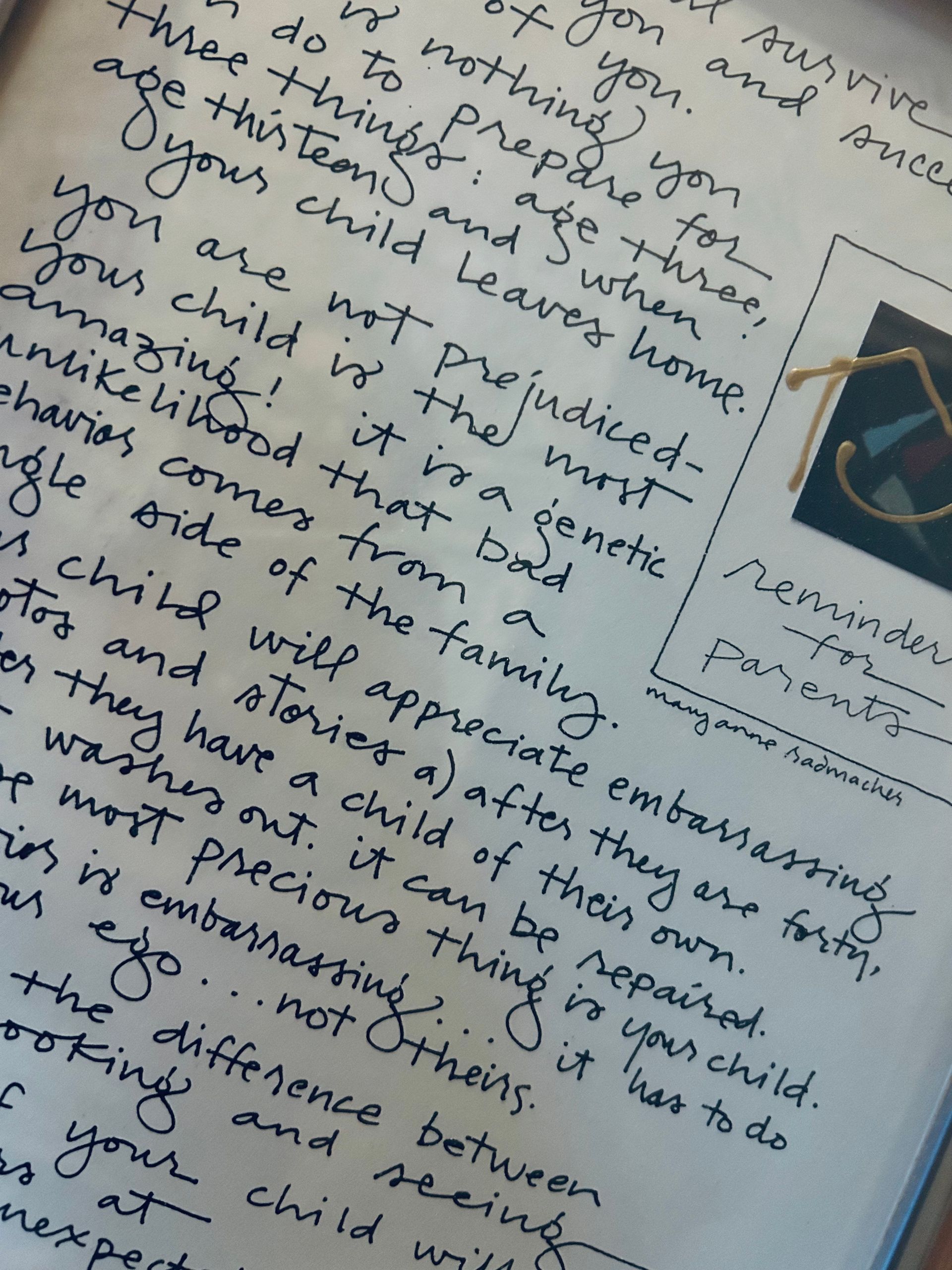
Sometimes you’ll be sitting on a gift that doesn’t make sense for you right at that moment, instead its value will show up many years later. That’s parenthood, actually, in a nutshell, isn’t it? We start off in complete wonder…confused as to what to do with this little being placed in our arms, our lives. We then spend years sharing our time, energy, finances, and body with a small tyrant (who, on better days, feels like a generous little narcissist). We invest all our resources in them and find ourselves collecting crayon-colored placemats as payments. Time slips by... the wobbly-lined drawings diminish, and suddenly we realize: these babies are on loan to us . {Ooof. Is that not a gut-punch?} Back to the poetry part. Nearly twenty years ago, my beautiful mama gave me a copy of one of Mary Ann Radmacher’s poems. If you don’t know Mary Anne’s work, she’s an artist and a writer. Her poems are as visual as they are lyrical. And honestly, when I read this poem initially, I thought it was sweet, but didn’t really connect with its message yet. I tucked it away in a pile of cards and papers, and found it again many years later when I was going through some bins. This time when I read it, I was knee deep into parenting. I was on the cusp of knowing that this (cue the wild gesturing) was all temporary. I likely had had a day that felt like it was seven hours too long, but the words on the page awakened me. They registered in my heart. I felt like Mary Anne Radmacher must be the most enlightened being to be able to summarize so many important parenting precepts in such a loving, honest, and moving manner. Since then, this poem, rescued from the bin of embarrassing photos and yellowing cards from people I no longer know, has been framed and on display in our home(s) for anyone else to read. I’ve included the poem below, but seeing the words in times new roman (excuse me, muli, to be most accurate) font just doesn’t have the same impact as Mary Anne’s scripty style. This is one of her older poems, so it’s very difficult to come by (I’ve tried), but the words are still worth hearing. Note: I’ve type it in the way it appears on my copy, knowing that the phrase breaks may or may not be intentional with the artwork that was also on the poem. I can’t wait to hear what you think of it and if you’d add anything. Maybe reading this will inspire you to make your own reminders. Peace and Love, ~A reminders for parents your child will survive because of you and succeed in spite of you. there is nothing you can do to prepare for three things: age three, age thirteen, and when your child leaves home. you are not prejudiced— your child is the most amazing! it is a genetic unlikelihood that bad behavior comes from a single side of the family. your child will appreciate embarrassing photos and stories a) after they are forty, b) after they have a child of their own. it washes out. It can be repaired. the most precious thing is your child. it behavior is embarrassing…it has to do with your ego…not theirs. remember the difference between looking and seeing. thoughts of your child will bring tears at unexpected moments. ~ mary anne radmacher
To Be or Not To Be, that is the question.

Let's call summertime what it really is.
Tips for Raising Children in an Anti-Hypermasculine Way

In my early 20’s, I lived in the heart of a big, vibrant city, freshly transplanted from a midwestern town. I was very newly married and I worked with kiddos who were impacted by a life-threatening illness or condition. By the time I was 26, I had graduated with a Master’s Degree in Child Development. I share those stats because, by most accounts, I had all the boxes checked for what might be the basis for a stable home for a child. But checked boxes doesn't always equate, or even predict, success. {Note: It’s cool if you did become a parent in your twenties or younger. I’m just sharing hindsight about why this worked out in my favor, k? No hate talk, because what I’m about to tell you is personal and flows with science and it’s not okay to mock either one of those things here. Thanks for understanding…carrying on with your reading.} Although I didn’t have the young girl fantasies of playing house or being a mom, it wasn’t that I was against that path either. I just didn’t see myself on it. (That’s because I didn’t know all the different roads that might lead to motherhood… but that’s for another post.) I spent most of my second decade of life doing what many people in their twenties do; learning how to be an employee, navigating all the responsibilities of living away from anything and anyone I knew, figuring out how to be in relationship with another adult, sharing space with that person, making sense of what overlapped between us and what didn't, and reacting to all of it. There are some moments I look back at now and cringe. I blame my behavior on being young, naïve, unexperienced, and desperate. I’m bagging on myself, but I’m not alone in this. Most people in this age group are blissfully unaware of what unhealthy patterns they carry, how they show up in relationships, and how to rebuild the hurting parts of themselves. In my twenties (and maybe even beyond), I just didn’t know myself yet. And that's why I'm glad motherhood came later for me. That twenty-something version of myself didn’t know the power of empathy yet. Sure, I had plenty of compassion, but I didn’t know my conditioned beliefs yet, because I wasn’t—couldn’t be--reflective at that time. I didn’t yet have the skills to take care of my inner child, let alone a real life child. Oh sure, I had the degree from the well-respected institute, but inner knowledge? Nope. You see, the brain takes approximately two and a half decades to fully mature. Researchers say anywhere between ages 24-28 is when the prefrontal cortex finally gets fully established. Skills like impulse control, planning, and judgement are handled in this part of the brain. These higher-order skills require higher-order processes. This all takes time (plus experiences) to develop. And it’s not like we get notification when the maturation is complete like we do with a software update. So hindsight and reflection is how we monitor our inner growth. We sometimes forget that young twenty-year olds are still in the developmental process. They’re still ripening. And, I’d argue that until the brain has finished cooking, we’re still trying on different costumes in life. We’re role playing a bit until we hit a point where our systems are ready to do the reflective and insightful work related to self-awareness. (And, yes, some people go their whole lives never even considering to do this work. But, if you're reading this, that's not you.) Becoming a parent is big responsibility. It takes resources. And not just financial—emotional--resources that call upon the higher order brain. Interestingly, the minimum age to adopt from some countries is around 30 years old. Coincidence? Perhaps not. What I know now, five decades in to life, is that becoming a parent in my 30’s allowed me time to grow. I’ll be honest, in some ways I envy the 20-something parents. They have energy. They’re more agile physically and mentally—they haven’t built as many rigid patterns yet. But if I had a chance to do it all over, have the same child, but at an earlier time in life, I wouldn’t do it. For me, and so many others I’ve coached, motherhood has really been the beginning of a personal quest to finding my core self. Not just about raising and walking alongside a child, but also re-raising and walking alongside myself, my inner child, and even my own parents and their inner-child-states. It gave me perspective to see the "why" behind my actions. I became aware of my auto-pilot mode. And I learned how to sort through my patterns and set aside the ones I’ve collected, but no longer need to carry throughout the years. I believe that children arrive in our lives at just the right time. But that “right time” can sometimes not make sense until much later. For anyone who's ever worried that they waited “too long” or have heard it’s “too late” to be a parent, maybe this post will resonate with you. Peace and love.

In my latest program course, Attachment 101: Patterns of Attachment , I explain the basic premise of attachment; how it's an evolutionary drive that is shaped by the child's primary caregiver. I borrow the phrase "ghosts in the nursery" from a 50-year old research paper that demonstrated the astonishing and lingering effects that early relationships have on our future lives. Whether you're a new parent, or a seasoned one, this program has takeaways designed to encourage you to see your "ghosts" as helping you rather than haunting you.

The holiday season is upon us! All the songs tell us it is "the most wonderful time of year," but for many families, the holiday actually doesn't feel all that wonderful. The hustle and bustle of all the extra people, pressure, and These are just a few ways to find peace with your kiddos this season. Rather than think of these as singular activities solely for this holiday vacation, look to the suggestions as a guide for how to connect with your child.

Dr. Dan Siegal gets all the credit for this clever and catchy phrase. Try it. See how it helps you and your child.

An excerpt from the newest digital course on DISCIPLINE

Helmets and knee pads aren't enough.